
Federal Prison Release Paths
The Federal Bureau of Prisons is a nationwide custody system, not a Burleson County institution. No BOP prison was identified in the county. A person can leave the county jail for federal custody through the U.S. Marshals Service, but that local movement is a transfer rather than a community release. Sentenced federal prisoners may later enter a BOP facility elsewhere.
A BOP exit may lead to the community, federal supervised release, state or local custody, or another detainer. A locator result marked Released or Not in BOP Custody confirms only that BOP custody ended. It does not resolve another authority’s custody or prove that every legal restraint ended.
| Person | Primary route |
|---|---|
| Sentenced federal prisoner | BOP Inmate Locator |
| Federal pretrial detainee | Federal court, USMS, or holding facility |
| Former BOP prisoner | Released result and displayed date |
| Possible other detainer | Named state, local, or immigration agency |
Confirm a BOP Release
The BOP Inmate Locator searches federal records from 1982 to the present. Search by federal register, DCDC, FBI, or INS number when known, or use exact name and identity details. The official explanation says a result listed Released or Not in BOP Custody, with no facility, means the person is no longer held by BOP.
- Search the strongest federal identifier available.
- Match the full name, age, race, and sex fields carefully.
- Read both the custody label and release date.
- Check another named authority if a detainer or transfer is possible.
A future date can change after First Step Act recalculations. UNKNOWN can mean the term has not been determined. The Burleson County release search covers county records when the federal path began at the local jail.
BOP Records and Locator Help
The locator is the first public route for sentenced federal custody. The BOP inmate-location policy and help page explains location assistance. For records beyond the public result, a BOP Freedom of Information Act request and identity certification may be needed. Federal prison records from before 1982 may require National Archives research.
Federal Bureau of Prisons
Nationwide federal prison system
Online source: BOP Inmate Locator
No BOP institution identified in Burleson County
Use the federal district-court docket for the detention or release order when the person is awaiting trial. The BOP locator is not a universal roster for prisoners held for USMS in contracted local jails.
No Burleson County BOP Prison
The facility map includes BOP because federal custody is a possible destination after a Burleson County jail transfer, not because a federal prison stands in the county. A local record marked USMS can indicate that the Marshals Service assumed custody. It should not be relabeled as a BOP release without a later federal record.
USMS has no general public historical release locator comparable to BOP. Follow the federal court docket, detention or release order, relevant Marshals district, and holding facility for a pretrial person. Someone may move between contracted sites without ever appearing as a sentenced BOP prisoner.
BOP Released Record Meaning
A former-prisoner result can display a past release date and no current institution. That is useful proof of exit from BOP on the listed date. It does not establish whether federal supervised release followed, whether a state sentence began, or whether immigration custody intervened.
- Released
- The person left BOP custody on the displayed date.
- Not in BOP Custody
- No present BOP institution is shown; another custodian remains possible.
- In transit
- A movement status that may not reflect a later court release.
- UNKNOWN
- A release term or date has not been determined in the displayed data.
Match the federal record to the court case and any Burleson County transfer entry. Those records establish different events and should not be merged into one assumed release.
BOP Official Record Images
The official BOP locator record explanation describes how former federal prisoners appear.
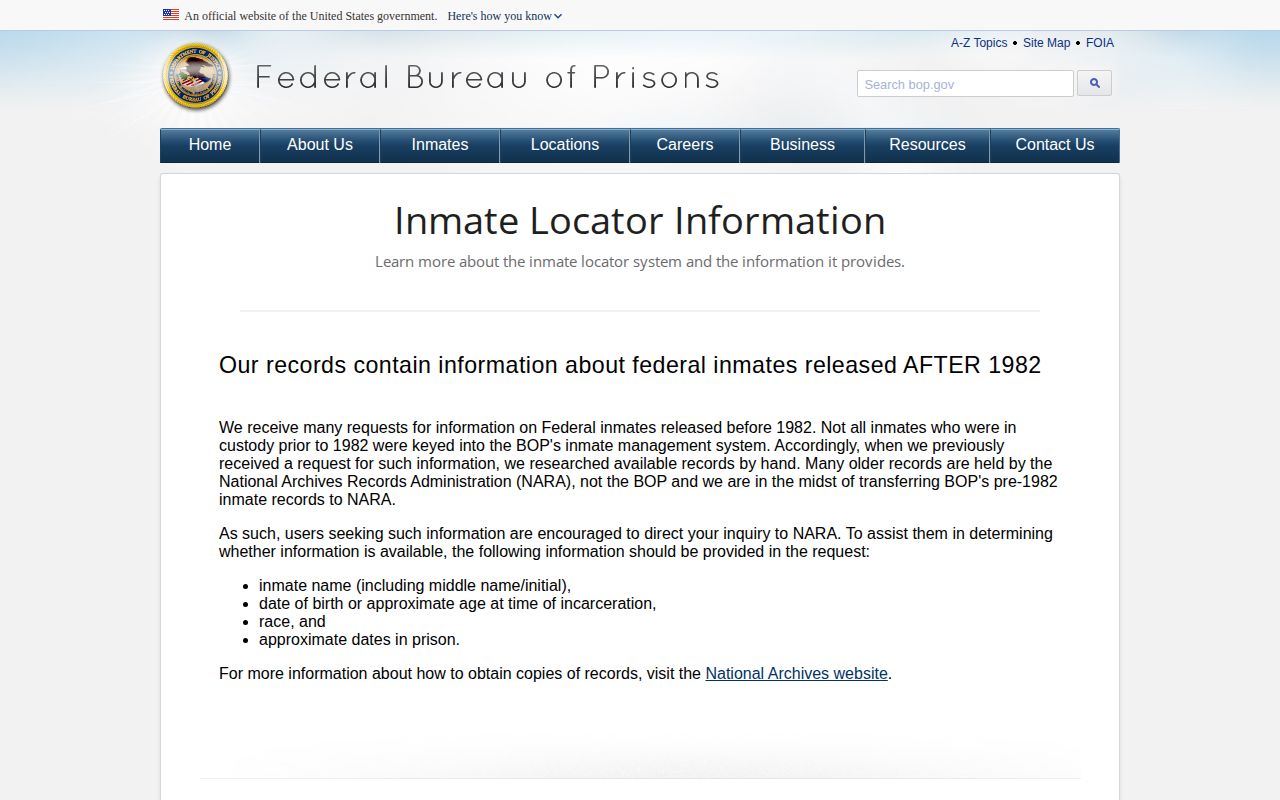
The image reinforces that a released federal result is custody-specific. It must not be used to infer county, state, or immigration status.
For a clean verification trail, save the federal number, exact result label, displayed date, and the court case identifier. If the county jail record says only that the person left for USMS, ask for the receiving-agency detail and then follow the federal source. Each step narrows the custodian without turning absence from one system into a claim of freedom.
Federal Numbers Improve Release Matches
A BOP result may retain a release date for a former federal prisoner after the person leaves the current population. It still does not supply the entire release packet or explain each later obligation. Compare that date with the federal judgment and docket. If the federal case began with a Burleson County transfer, retain the Sheriff movement record too. Three records can describe separate events without conflicting: exit from the county jail, a federal court decision, and the later end of BOP custody. Preserve the exact federal identifier and displayed status with the date checked. That detail lets a later reader distinguish a matched historical result from a name-only assumption.
Name searches can return more than one federal prisoner. A register number is usually the strongest key because it follows the individual through BOP records. The locator also accepts DCDC, FBI, and INS numbers. When no number is known, use the exact first and last names, then compare age, race, and sex rather than choosing the first similar result. Suffixes, middle names, aliases, and spelling changes can affect the match.
Record the query and the date it was run. A negative result means only that the submitted identity did not produce a match in that database at that time. It does not establish a community release. For a person whose federal path began at the Burleson County Jail, request the county movement record and compare its receiving authority with the federal case. The county record proves the local exit; the federal record addresses what happened afterward.
Getting Federal Release Records
The public locator offers a concise result, not the complete prison file. When the displayed status and date are insufficient, request an existing BOP record through the agency's Freedom of Information Act process. Identity certification may be required for records about a named person. Ask for a defined item, such as the custody history or release record, and include the federal identifier when available. For prison custody before 1982, the National Archives may be the better record source.
Federal district court records serve a different purpose. A detention order, release order, judgment, or docket entry can explain the legal event, yet it may not show the exact moment someone left a holding facility. Pair that court material with the custodian's record. If USMS held the person before sentencing, consult the official USMS prisoner-information guidance and the relevant district or holding facility. USMS movement is not interchangeable with BOP release.
Burleson Federal Release Evidence
Use documents according to what each one can prove. A Sheriff custody record can show when Burleson County custody ended and which authority received the person. A federal court order supplies the legal basis for detention or release. A BOP historical result can show the date BOP custody ended. If another state, local, or immigration hold existed, that agency's record completes the chain.
| Record | What it establishes | What it cannot establish alone |
|---|---|---|
| County movement entry | Exit from the Burleson County Jail | Exit from federal custody |
| Federal court order | Judicial detention or release decision | Exact physical departure time |
| BOP released result | End of BOP custody on the shown date | End of all other custody or supervision |
| USMS record | Pretrial movement or federal custody event | A sentenced-prisoner BOP history |
The Burleson County released-inmate search explains how county, state, federal, and immigration paths fit together. Keep each source's label intact. That approach prevents a transfer, court milestone, or database absence from being reported as a broader release than the record supports.