
Burleson Parole and Probation Differences
Texas uses two separate systems. The Texas Board of Pardons and Paroles decides whether an eligible state prisoner may leave prison on parole or mandatory supervision. The TDCJ Parole Division then supervises that release. Probation, called community supervision in Texas, is ordered by a court and administered through a Community Supervision and Corrections Department, or CSCD. A Burleson County defendant can go straight from the county jail or courtroom to probation without entering TDCJ.
Parole is conditional release from incarceration while part of the sentence remains. Mandatory supervision is another supervised TDCJ release form governed by Texas law. Probation places a person under court conditions in the community. Discharge means the relevant sentence or supervision term has ended, though another case or authority may still matter. None of these labels supplies the exact jail exit time by itself.
| Record type | Decision maker | Verification route |
|---|---|---|
| Parole | Board of Pardons and Paroles | TDCJ Parole Division and release record |
| Mandatory supervision | Board review under applicable law | TDCJ status and assigned parole office |
| Probation | Sentencing court | Court judgment, docket, and CSCD |
| Sentence discharge | Sentence calculation and legal authority | TDCJ or court discharge documentation |
Verify Burleson Post-Release Supervision
No verified statewide public name index lists every Texas parolee. TDCJ's online inmate search is limited to people currently incarcerated, so absence from it does not establish parole, probation, or discharge. Use exact identity details, including full name, date of birth, TDCJ or SID number, and the Burleson County cause number when known.
- Read the judgment or docket to determine whether the order says probation, incarceration, parole eligibility, or another result.
- For a pending parole review, call the Board review-status line at 844-512-0461 with the identifying information.
- After a favorable vote, call the TDCJ Parole Division release-status line at 512-406-5202. Approval is not physical departure.
- For current parole supervision questions, use the official parole information route or ask which district office serves the case.
- For probation, confirm the order with the Burleson County clerk that holds the case, then use the official CSCD directory for office routing.
Burleson County Parole Office
TDCJ maps Burleson County to the Bryan/College Station District Parole Office in Region I. The county-to-office map identifies the geographic office, not a named person's supervision status. Call for a legitimate office-routing need and expect limits on personal case details.
Bryan/College Station District Parole Office1700 George Bush Drive East, Suite 150
College Station, TX 77840
Phone: 979-693-4977
Fax: 979-693-3374
The official parole office lookup by county shows the Burleson assignment. The captured directory view illustrates where to confirm that mapping.
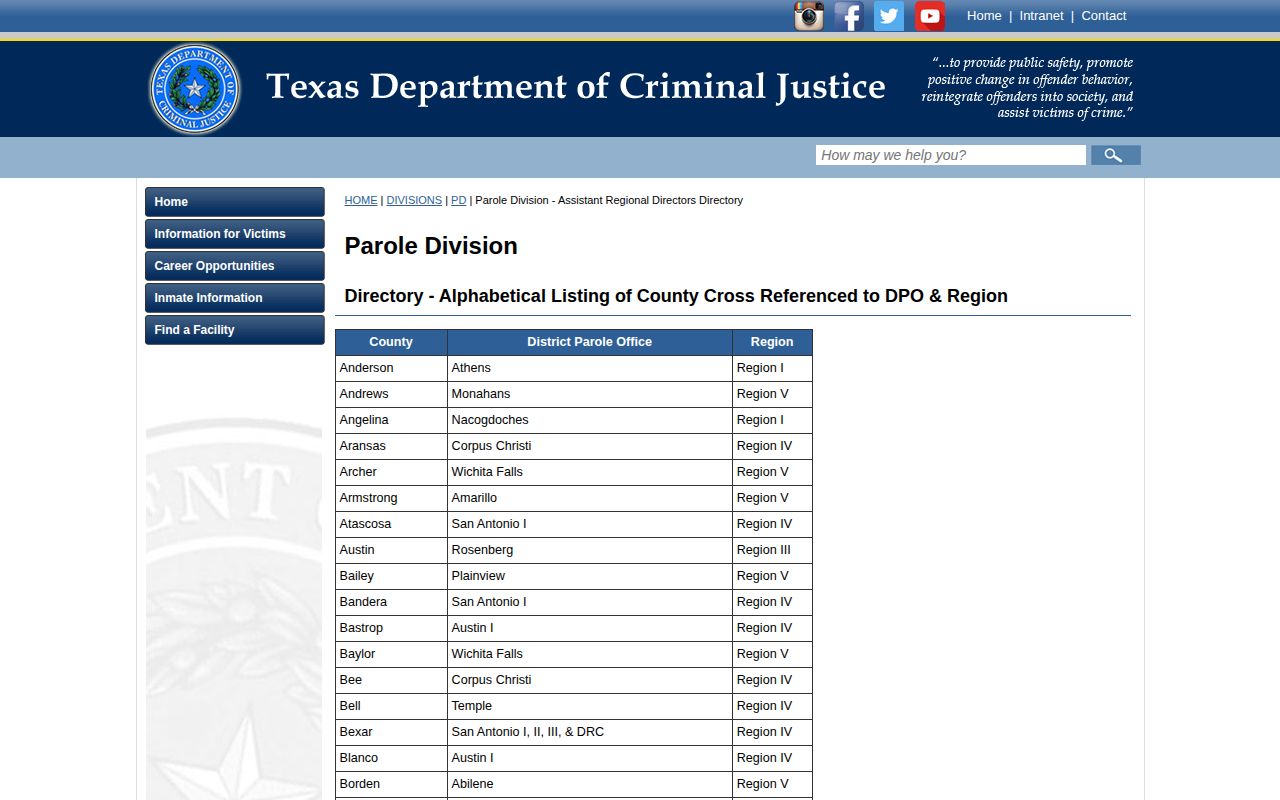
The directory does not replace a TDCJ release record or prove that a person reports to that office.
Burleson Probation Uses CSCD
The Burleson County District Clerk supplies a useful local marker: its page says court-ordered criminal fees are paid through the Community Supervision and Corrections Department. That separates court probation from both county jail custody and TDCJ parole. Start with the signed judgment because it identifies the order, term, and court. Felony records generally route through the District Clerk, while county-level misdemeanor matters generally route through the County Clerk and county court.
The official TDCJ CSCD directory supplies current office routing. It does not prove that a person is compliant, has completed supervision, or has no later warrant. Ask the clerk for the docket and judgment, then ask the proper CSCD only for information it may lawfully provide. The jail can confirm its own custody event, but it is not the long-term probation record keeper.
For a release record connected to the local jail, the Burleson County Jail remains the source for the actual exit date, time, and release or transfer code.
Burleson Parole Decisions Are File Votes
Texas does not hold ordinary public inmate-by-inmate hearings for parole or mandatory-release review. Board panel members review and vote case files individually. A requested panel-member interview is not a formal hearing and does not promise an outcome. Except for qualifying people registered through Victim Services, the Board says it does not notify the public of an upcoming review date.
The Board's governance meetings are different. Its meeting and workshop archive contains administrative notices and minutes, not a calendar of Burleson County prisoner reviews.
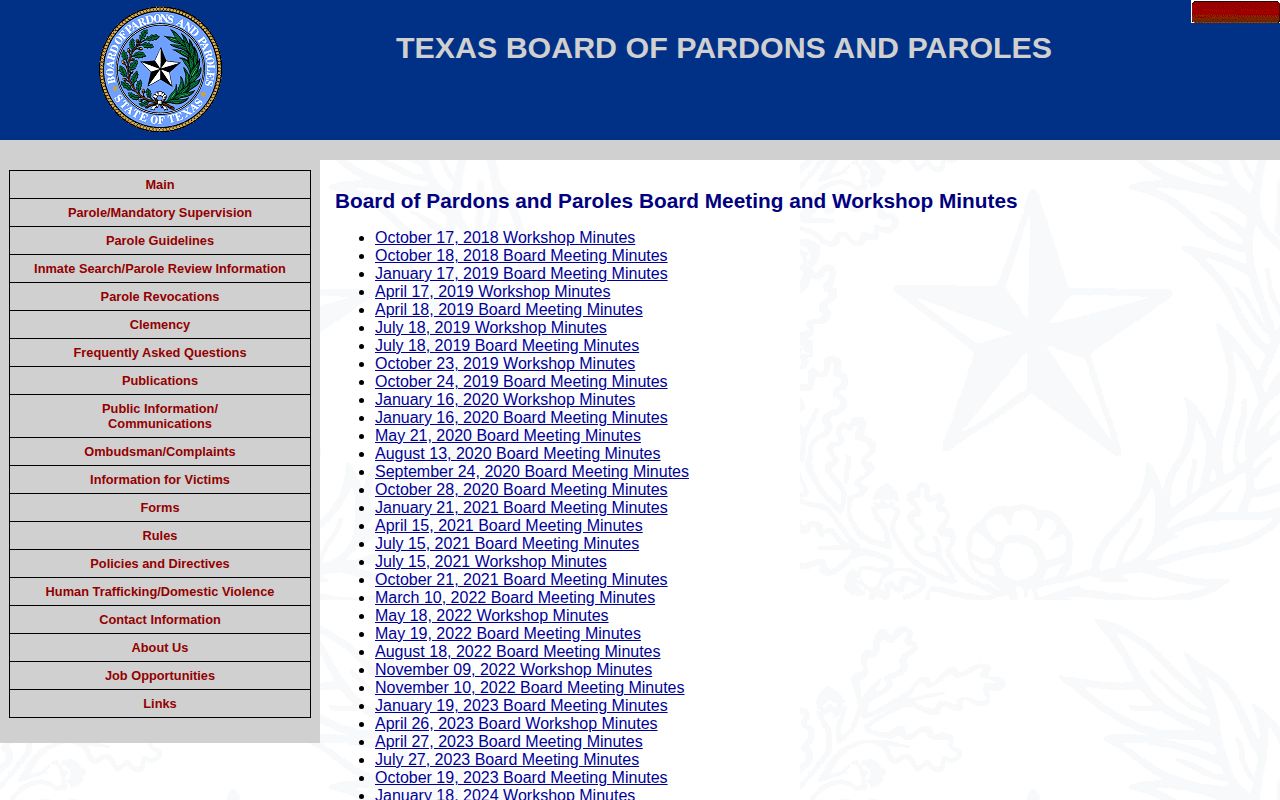
The distinction prevents a Board meeting date from being mistaken for an individual's parole review date.
Read Burleson Parole Results Carefully
The official parole decision guide explains common Board results. Favorable action, often shown as FI, may be tied to a date, program, or prerequisite. NR means the next review comes later after denial. Serve-all can mean remaining in custody until a mandatory-supervision date or discharge. Mandatory-supervision approval and denial have separate results.
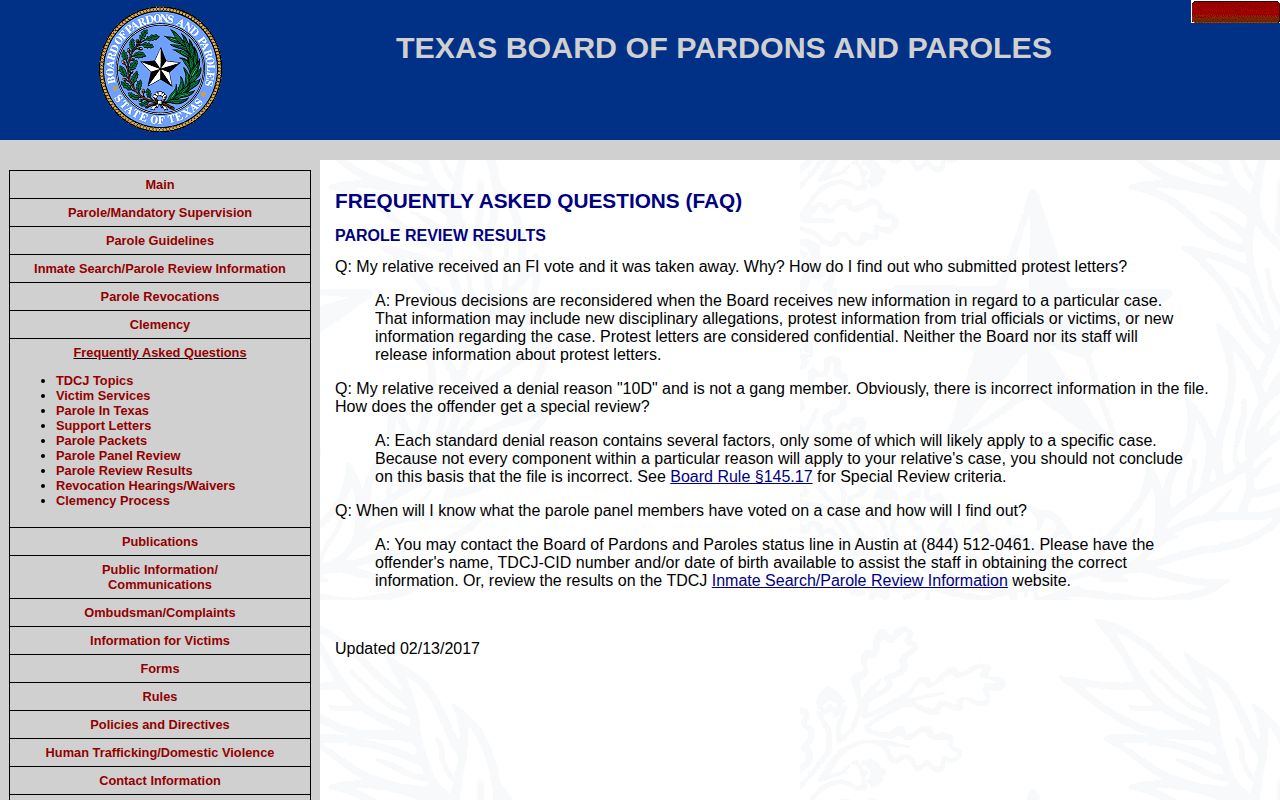
A favorable vote can be reconsidered or rescinded before departure. Programming, release-plan review, detainers, and processing can also stand between a vote and physical release. Confirm the actual event through the release-status line and TDCJ records.
Burleson Supervision Violations and Warrants
No official Burleson County public absconder or parole-warrant list was identified. An absconder is a supervised person alleged to have stopped reporting or whose location is unknown under the agency's rules. A violation allegation can lead to a warrant and new custody after an earlier release. A stale parole or probation entry does not prove present compliance or present custody.
Revocation is the process that may withdraw supervision after a claimed violation. It is separate from the first parole file review. For parole or mandatory supervision, use TDCJ and the Board's revocation hearing process. For probation, use the sentencing court docket and the CSCD. A new jail booking should be checked with the Sheriff rather than inferred from a supervision record.
Texas IVSS can provide status-change notices for TDCJ custody and parole, but an alert is a prompt to verify. It is not a certified discharge record.
How Burleson Supervision Ends
Parole, mandatory supervision, and probation do not end merely because a name disappears from a current-custody search. The controlling sentence, discharge action, or court order determines the end. For TDCJ supervision, request the actual release and discharge history through Parole Division records. For probation, obtain the court docket, completion or discharge order, and any CSCD documentation available through the proper channel.
Keep the legal event separate from the physical event. A Board vote may authorize a future release. A jail custody record shows when county custody ended. A parole record shows conditional state supervision. A discharge record shows that the stated term ended. Matching those records by identifiers and cause number gives a sound Burleson County timeline without treating a missing roster result as proof.
General TDCJ information is available at 936-295-6371 or 800-535-0283 on weekdays from 8 a.m. to 5 p.m. The agency asks for an exact date of birth when no TDCJ or SID number is available.
Trace Burleson Probation Records
A Burleson County probation check should begin with the criminal judgment, not a prison locator. The judgment or docket identifies the sentencing court, states whether community supervision was imposed, and may list the term and key conditions. The District Clerk handles felony matters, while county-level misdemeanor records ordinarily begin with the County Clerk. Use the full legal name, date of birth, cause number, charge, and approximate filing date to keep similar identities apart.
Ask for the docket sheet, judgment and sentence, community-supervision order, and any later modification, revocation, completion, or discharge order. Those documents show the legal course of probation. They may not show the exact hour the person left Burleson County Jail, so pair them with the Sheriff custody history when the physical release event matters. A person can leave jail on probation without ever entering TDCJ custody.
The official TDCJ CSCD directory is the routing source for the current Community Supervision and Corrections Department office. It should be checked rather than assuming that the Bryan/College Station parole office handles probation. That parole office serves Burleson County parole geography, but the two systems have different authority and records.
Build a Burleson Supervision Timeline
Use separate entries for the Board decision, physical release, start of supervision, later status changes, and discharge. Each answers a different question. A favorable Board action may include a program or other prerequisite and can be reconsidered before departure. The TDCJ release-status line can clarify progress after a favorable vote, while the final custody record establishes when incarceration actually ended.
For parole or mandatory supervision, preserve the TDCJ or SID number with every result. For probation, preserve the Burleson cause number and court. If a violation is alleged, check the supervising agency and the proper court or Board process instead of treating an old supervision entry as proof of current custody. No official public Burleson absconder list was found, so a general web search cannot replace those first-party channels.